Email Sign-Up
This form allows visitors to subscribe to informative emails and updates without requesting a design consultation.
Solar panels generate electricity, but a battery gives you a way to save some of that energy for later. If backup power is a priority, choosing the right storage system matters just as much as choosing your panels.
Fortress Power is one option for solar battery backup. How does it compare with Tesla Powerwall, Rubix, and EG4? The answer starts with your backup priorities, existing equipment, and the amount of energy you want to store.
Fortress Power makes lithium iron phosphate, or LFP, batteries for solar energy storage. Its lineup includes different battery sizes and configurations, so a Fortress recommendation should identify the exact model and compatible inverter.
For example, the eFlex MAX provides approximately 5.4 kWh per battery, with wall or floor mounting options. The eVault MAX provides 18.5 kWh in a floor-standing unit. These batteries require compatible power-conversion equipment to supply household AC electricity.
Those differences matter when planning your installation. Several smaller batteries and one larger battery can have different space, wiring, and expansion requirements, even when their total storage is similar.
Let’s break this down even further. Here are a few specific reasons why we love this Fortress Power battery:
Obviously, aesthetics aren’t everything, but we do really like the look of this Fortress Power battery! It has a clean-looking white metal case and looks good even when installed on a wall. In addition to that, this Fortress Power battery has a sleek, compact design that makes it flexible and easy to install. If you want the battery backup to be floor-standing or wall-mounted, you can rest assured that this compact design will be just what you need.
| Battery option | Published energy rating | Main comparison point |
| Fortress eFlex MAX | About 5.4 kWh per battery | Separate compatible inverter; smaller modules offer sizing flexibility. |
| Fortress eVault MAX | 18.5 kWh per battery | Separate compatible inverter; floor-standing storage in a larger unit. |
| Tesla Powerwall 3 | 13.5 kWh AC per unit | Integrated solar inverter and Tesla app controls. |
| Rubix Stack Series | 5 kWh per module | Modular stacks and Sol-Ark communication. |
| EG4 WallMount 280Ah All Weather | 14.3 kWh per battery | Separate compatible inverter; outdoor-rated enclosure and self-heating. |
Product references: Fortress eFlex MAX, Fortress eVault MAX, Tesla Powerwall specifications, Rubix batteries, and EG4 WallMount.
Powerwall 3 combines battery storage with an integrated solar inverter. Tesla publishes 13.5 kWh of energy capacity and up to 11.5 kW of continuous output, subject to the installation configuration. Its app brings monitoring and operating controls into the Tesla ecosystem.
Fortress battery models such as eFlex MAX use a separate compatible inverter. That gives you a different equipment path to compare, especially if you already have solar. Ask which option works with your existing equipment and what changes each proposal requires.
Rubix solar batteries use 5 kWh modules to create a storage bank sized for the property. They communicate with compatible Sol-Ark inverters to report information such as charge level, temperature, and battery cycles.
Both Rubix and Fortress offer modular storage approaches. Compare the exact battery-and-inverter pairing, expansion limits, monitoring, and local service support. A similar storage total does not automatically mean two systems can run the same appliances.
EG4’s WallMount 280Ah All Weather battery offers 14.3 kWh of storage, integrated self-heating, and communication with selected compatible inverters. Its outdoor enclosure may be relevant when indoor space is limited.
Compare that installation arrangement with the specific Fortress model under consideration. Mounting location, charging-temperature limits, inverter compatibility, and the full installed price are more useful decision points than brand names alone.
Traditionally, batteries and battery banks are a secondary amenity for solar power systems. This is largely because most solar power installations are grid-tied systems, where having a battery backup isn’t necessary.
However, a Fortress Power battery backup will enter the discussion when we look at off-grid and hybrid solar systems. Let’s do a quick overview of these two types of solar systems:
With an off-grid solar system, a solar panel array collects energy from the sun and converts that energy to consumable power for your appliances (AC current). During the day, your appliances will run off of this AC current, and any excess power will be used to charge the Fortress Power Battery. When the sun is no longer supplying energy (during nighttime or a storm), your charged Fortress Power battery bank will take over and continue to supply your home and appliances with power.
A hybrid solar system (commonly referred to as grid-tied solar with battery backup) performs a little differently. Like the off-grid system, the solar panel array collects energy from the sun and converts that energy to consumable power for your appliances (AC current). Again, the excess power is then used to charge the Fortress Power battery bank.
However, here is where the difference lies. Any excess power not being consumed or stored in the battery bank gets directed back onto your local grid. This has the potential to offset your cost of consumed grid power that your system will rely upon when the solar panel array is not collecting sunlight. Furthermore, if the grid fails, your Fortress Power battery bank can continue to supply your appliances with power from its charged cells.
Our projects show how battery storage can be matched to different properties and goals. These installations feature Rubix, EG4, and Tesla equipment, offering useful examples as you compare a Fortress proposal with other options.
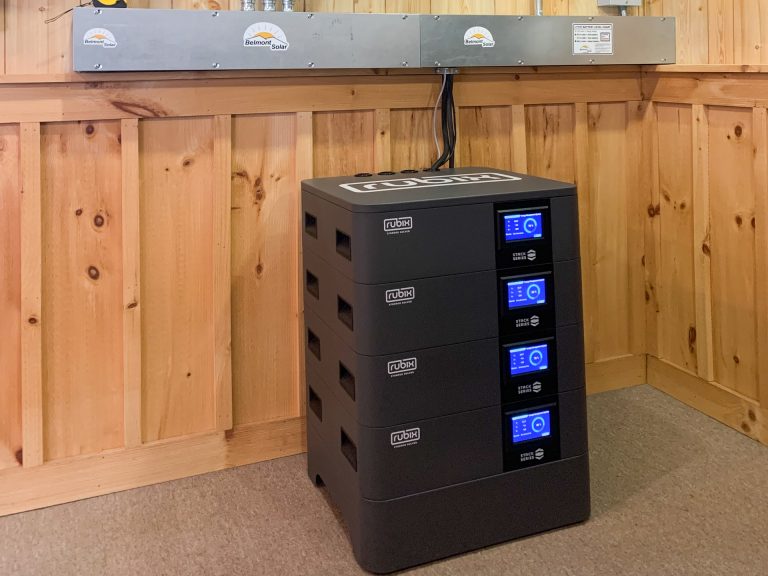
For a homeowner in Manheim, we paired a Sol-Ark 15K hybrid inverter with eight Rubix Stack Series batteries. Each module provides 5 kWh, creating a battery bank with 40 kWh of usable storage.
The homeowner wanted lower energy costs and a way to store surplus solar electricity for later. This project illustrates how multiple modules can create a larger storage bank as part of a custom solar installation.

This Phoenixville homeowner wanted solar generation and backup power in one installation. We installed a 20 kW hybrid solar system with 46 panels and an EG4 battery system providing 28 kWh of storage.
The project shows why solar-array size and battery capacity should be listed separately. The panels generate electricity, while the battery stores energy for use when it is needed.

In Oxford, we added Tesla Powerwall storage to an existing grid-tied solar installation. The homeowner wanted stored energy available when solar generation was lower.
For someone who already has panels, this is a useful example of a battery addition. The right equipment and electrical changes still depend on the existing installation.
Well, that about does it for a quick overview of this Fortress Power battery. If you would like to learn more about battery backup for solar, we actually have an extensive page devoted to this very topic. In addition, if you would like to learn more about this Fortress Power battery specifically, you can visit the product page here.
As always, we at Belmont Solar want to be a helpful source to anyone on the solar journey. If you have questions about battery backup, please reach out to us. We love helping people just like you experience the amazing benefits that battery backups present!

It's a Fusion Reactor in the sky, a safe distance away. No need to invent a new one.